Who should consider a Norwegian Buhund?
- Folks with a very Nordic sense of humor… drinking games with a giant, anyone?
- Anyone competing in dog sports, especially if you want to be a “big fish in a small pond” for a change! If you’re active in your sport, you can expect invitations to AKC National events because the field of Buhunds is sports is currently very small.
- Dog sport hobbyists who have raised at least one other herding breed puppy—your Buhund will be “border collie lite,” in many ways.
- Avid outdoor enthusiasts who hike (or otherwise spend time in nature) 3+ times per week—with a solid foundation of recall training, you will have a fabulous off-leash hiking buddy
- Foresters, conservationists and others with semi-nomadic, outdoors-y lifestyles—these dogs love to go to work with you!
- Experienced working dog owners in need of an all-purpose farm dog—vermin control, light herding duty, and a dependable watchdog all in one.
- Crazy dog people whose lives already revolve around decompression and dog-ness—this is me, FYI.
Who should NOT consider a Norwegian Buhund?
- Folks who do not find humor in BOTH the Prose Edda and Poetic Edda. If you haven’t read these… well, now you have homework. If you have read these and don’t care for the humor, maybe consider a Border Collie or Belgian—depending whether you prefer Fawlty Towers or Poirot, respectively. I know that seems a bit goofy, or pretentious, but truly, these dogs have a very Nordic sense of humor and will find ways to needle and goad you…mostly in good fun.
- Anyone with household members or nearby neighbors who can’t abide at least some barking. Buhunds can be taught not to bark at everything, all the time, but they’re still a vocal breed with a vocabulary of barks, whines, yips and yodels for every occasion. Using a bark collar will lead to behavior problems such as fearfulness, noise phobia, reactivity and stereotypical or superstitious behavior.
- First-time or newer dog owners. I’m willing to take a chance and help folks who want to get into this breed and don’t have much experience, but you’ll need a strong and well-qualified support team in order to be successful with a Buhund.
- Trainers who expect a dog to be competition-ready at 18 months of age (or younger). This breed in extremely slow to mature, and while there are plenty of exceptions, I personally would never consider competing with a dog under 3 years of age. Training should begin from the day you bring your puppy home, but it needs to be fun, fair, and flexible or your Buhund will opt out.
- Folks who need their dog to be able to handle being crated 8+ hours every day.
- Anyone who needs a dog to be able to spend time outdoors during the day while home alone/otherwise unsupervised (a buhund, particularly a young one, will make their own entertainment while you’re away by escaping, destroying landscaping, and of course, by barking)
- Anyone who can’t devote 4 or more hours/day to their puppy for the initial 24 months of their puppy’s life. Take a look at your typical schedule—if you can’t see a way to cram in at least 2 hours of interaction, enrichment, and supervision on both ends of your day, this is not the breed for you. Buhunds thrive on time with their people, and will suffer and develop behavior problems if you can’t accommodate this.
- Anyone who doesn’t/can’t spend daily time in nature. For clarification, see my discussion of decompression walks below.
- Anyone who can’t allow their dog to dig (in an appropriate location). Digging is a species-appropriate behavior and Buhunds are experts in the matter. They can be taught to dig in a designated location (e.g. a sandbox), but must be allowed to exercise this behavior in some way.
- Families with more than 2 children under the age of 16—having a buhund is a lot like having an extra child—intelligent, destructive, and demanding. If you are juggling sleep schedules or extracurricular activities for more than 2 children already, do you really want the equivalent of another child in the mix?
- Folks who are house proud. I clean my house with a shop vac and a garden rake, and it still looks like a hoard of vikings (and their dogs) live there.
Why off-leash hiking? Why not frisbee, ball, or the dog park?
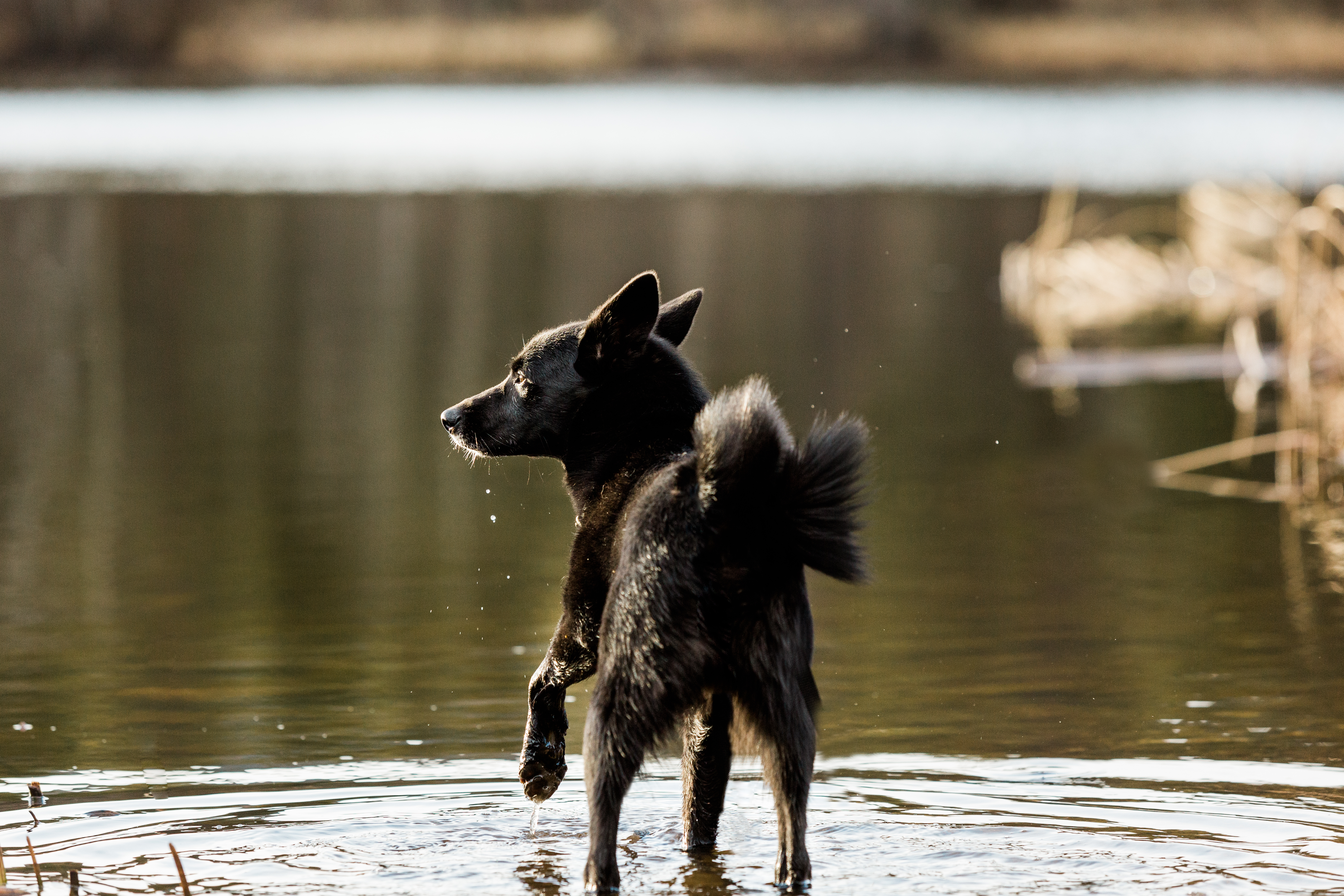
Off-leash hiking, the way we do it, is best described as “decompression.” The point is not so much the distance we cover, but rather the freedom the dogs have to move their bodies naturally—to run, walk, jump, roll, and most importantly, sniff, with minimal human intervention. I require my dogs to stay within visual range, check in with me on their own, and yes, have a good recall when necessary (plus a few other good trail-manners and skills), but I do my best to just let them “do dog things.” This is the critical piece missing for most dogs living in suburban or urban environments—the chance to perform normal, species-typical behaviors in nature. If you watch a dog’s body language when they’ve reached the state of decompression, their body looks relaxed and neutral and so does their behavior. In comparison, a dog waiting for the next throw of the ball is coiled like a spring, and performing repetitive, risky, high-impact behaviors repetitively—while that’s exhausting and may work well to simply tire the dog’s body, it does nothing to help calm their mind (which is why “fetch” often works against us when we try to teach our dogs how to settle indoors). Similarly, dog parks are highly stimulating (and very risky) environments that do more to stress your dog, even if they play until they’re exhausted, than to decompress them.
 Yggdrasil Norwegian Buhunds